Friday, April 29, 2022
When We Fell Apart - Soon Wiley
Wednesday, March 3, 2021
We Begin at the End - Chris Whitaker
Begin at the End is Chris Whitaker's new novel - and it's a fantastic read on so many levels. And that's also the opinion of one of my favorite authors - here's what Louise Penny had to say...."This is a book to be read and reread and an author to be celebrated."Monday, January 4, 2021
The Midnight Library - Matt Haig
Monday, April 13, 2020
Giveaway - The Gringa - Andrew Altschul
Q and A with Andrew Altschul, author of The Gringa
The Gringa is inspired by the real-life story of Lori Berenson, an American who was sentenced to 20 years in prison for terrorist activities in Peru in the 1990s. What about Berenson’s story inspired you to base this historical novel on it?
I lived in Peru for a couple of years in the late 1990s, soon after Berenson’s arrest and trial. Even though she was in a military prison, she was still in the news from time to time, and every time her name came up people went crazy – she was the most hated person in Peru, the foreigner who’d come to try and restart a war (or so the government alleged). I was intrigued by this, and also by the question of what had brought her there. She and I have certain things in common – we’re the same age, we both grew up in secular Jewish families in the New York area, went to great schools, etc. etc. I like to think of myself as a liberal or even a leftist, but I had never gone “all in” the way Berenson had, or really risked much of anything in the name of my political beliefs. So there was something about her story that was both chastening and frightening to me, and part of writing the novel was to try and understand why one of our lives went in one direction, and the other’s went in such a different direction.
The point of view in the novel is that of an American journalist living in Peru. How closely is that perspective based on your own life experiences?
Well, he’s sort of a “reluctant” journalist – he’s a failed novelist and a “refugee from George W. Bush’s” America, who gets strong-armed into writing the story of this paroled terrorist. He’s left the U.S. for a lot of reasons, and many of them are somewhat similar to mine. And his life in Peru, too, isn’t so different from mine – he thinks only of himself and his enjoyment, rather than trying to do anything to contribute to this country he claims to love. In that sense, he’s an exaggerated version of me, and I wanted to use Andres to both investigate this American propensity for self-centeredness and self-misunderstanding and to maybe think through what it might take to get Americans to think in more complex and responsible ways about the lives of people in the rest of the world.
What did you learn from researching and writing the novel about the ways in which people get involved with radical groups and how they transition from activist to radical?
I learned that it’s often, as Hemingway supposedly said about bankruptcy, “little by little and then all at once.” That is, not many people join radical groups in the hopes of killing people or blowing up buildings or hijacking planes – they join because they see these groups as dedicated to change and potentially more effective than traditional political avenues. The groups themselves usually start as “legitimate” political groups, and slowly evolve or factionalize as members grow dissatisfied with a lack of results. (Weather Underground split off from SDS precisely because they felt SDS wasn’t ready to do what it took to be effective). So someone who joins to take part in nonviolent protest, seeing that such protest isn’t working – and in fact is often provoking violent responses from the police or government – might slowly grow willing to consider… other tactics. Or they might not quite grasp how the group itself is changing around them, until suddenly the “actions” start to cross the line, but because of their dedication or solidarity they feel they have to stand with their comrades. I think the psychology varies.
Did you feel a burden to be 100% historically accurate in your depictions of the war and conflict in Peru?
In my depictions of the war and the history of Peru: yes. This is serious, life-and-death stuff, and a novelist has no business manipulating history to make a “better story.” That is, my protagonist and her colleagues in the group I’ve called the Cuarta Filosofía have some similarity to real-life persons, but the specific things they did and said are purely fiction. I did not set out to write about the “real story” of Lori Berenson, or the MRTA. But I placed them in a context which I took tremendous pains to keep accurate to the realities of the war, and to the reactions of the government and the Peruvian people. I had no right to do otherwise. At the same time, one of the most interesting things about writing the book was discovering that there is no “authoritative history” of the conflict – and in fact many people I talked to and many sources I read told very different stories, disagreeing even about “objective” facts like dates, statistics, etc. This was challenging for me, and really slowed down the writing – until one day I was talking to a Peruvian friend who’d been a student activist during this period, and he said, “But Andrew, that’s always how it is. No two Peruvians agree on what happened or why.” Once I understood this, I knew that my novel had to take precisely this approach, to look at the history of the war as something unstable, ever-changing, subject to manipulation and bias. It makes the novel more challenging, I think, but also, I hope, makes it “truer” to the experience of anyone who lived through the conflict.
How long did it take you to write this book? What was your writing and research process like?
It took eight years. It was the hardest thing I’ve ever written – largely because of all these ethical questions: How do you write about a war? How do you write responsibly about another culture, another history, particularly a history that claimed so many lives? I worked on it nonstop, and made four or five extended trips back to Peru to talk to people and get to know Lima better than I had when I lived in Cuzco. But there were many times when I thought I wouldn’t be able to finish it, that I just had no business, as a privileged white American, trying to take on this material. “Who am I to write this?” I kept asking myself. “Who am I?” What finally turned it for me was a conversation I had with a journalist friend, who told me, “You’re Lori Berenson.” What she meant was that I, too, was an outsider, an interloper, a gringo, and so there was a direct analogy between my relationship to the material and Berenson’s relationship to Peru and its history. It was this realization – that I had to write it from the perspective of someone who doesn’t really know how to write it, and maybe has no business writing it, and that I had to cop to that in the form of the novel itself – that enabled me to finally finish writing it.
What has the experience been like of publishing your book in the midst of a global pandemic?
It’s been great! Ha ha. It’s been hell. I had five events set up during the week after publication, and ten more throughout March and April – but as I travelled from city to city I would get notified almost as soon as I arrived that the event was cancelled: Worcester, MA; Providence, RI; New York City, Denver, San Francisco… one by one, they all went down. I spent nearly a year putting this tour together and I’m crushed. And since then, I’ve spent all day every day trying to shore up the book through online events, social media posts, etc. It’s far more exhausting than the book tour would have been, and I feel like it’s just getting started. Still, there have been some nice things, one of which is forming a kind of unexpected fellowship with other authors in the same boat, sharing tips and experiences with them, recommending one another when we hear about possible events, etc. I’ve always been a big believer in the literary community, and the outpouring of support I’ve heard – for authors, for bookstores, for small publishers – has been a real silver lining through this difficult time.
Thanks so much for stopping by Andrew. Read an excerpt of The Gringa.
"Andrew Altschul is the author of the novels Lady Lazarus (2008) and Deus Ex Machina (2011). His work has appeared in Esquire, McSweeney's, The Wall Street Journal, Ploughshares, Fence, One Story, and other publications, and in anthologies including Best New American Voices, Best American Nonrequired Reading, and O. Henry Prize Stories. A former Wallace Stegner Fellow and Jones Lecturer at Stanford University, he has received fellowships from the Bread Loaf and Sewanee Writers Conferences, the Ucross Foundation, the Fundación Valparaíso, and the Rockefeller Foundation Bellagio Center. He was the founding books editor at The Rumpus and is a Contributing Editor at Zyzzyva. The former director of the Center for Literary Arts at San Jose State University, he now directs the Creative Writing program at Colorado State University. He lives in Fort Collins, CO." You can connect with Andrew on his website, like him on Facebook and follow him on Twitter as well as on Instagram.And if you'd like to read The Gringa, enter for a chance to win a copy using the Rafflecopter form below. Open to US only, no PO boxes please. Ends April 25/20.
Monday, January 14, 2019
Giveaway - Everything Here is Beautiful - Mira T. Lee
What's it about? From Penguin Books:
"A dazzling novel of two sisters and their emotional journey through love, loyalty, and heartbreak.
Two Chinese-American sisters - Miranda, the older, responsible one, always her younger sister’s protector; Lucia, the headstrong, unpredictable one, whose impulses are huge and, often, life changing. When Lucia starts hearing voices, it is Miranda who must find a way to reach her sister. Lucia impetuously plows ahead, but the bitter constant is that she is, in fact, mentally ill. Lucia lives life on a grand scale, until, inevitably, she crashes to earth.
Miranda leaves her own self-contained life in Switzerland to rescue her sister again - but only Lucia can decide whether she wants to be saved. The bonds of sisterly devotion stretch across oceans - but what does it take to break them?
Everything Here Is Beautiful is, at its heart, an immigrant story, and a young woman’s quest to find fulfillment and a life unconstrained by her illness. But it’s also an unforgettable, gut-wrenching story of the sacrifices we make to truly love someone - and when loyalty to one’s self must prevail over all." Read an excerpt of Everything Here is Beautiful. Book clubs - there's also a reading guide.
"Mira T. Lee’s work has been published in numerous quarterlies and reviews, including The Missouri
Review, The Southern Review, Harvard Review, and Triquarterly. She was awarded an Artist’s Fellowship by the Massachusetts Cultural Council in 2012, and has twice received special mention for the Pushcart Prize. She is a graduate of Stanford University, and currently lives with her husband and two children in Cambridge, Massachusetts. This is her debut novel." You can connect with Mira T. Lee on her website, like her on Facebook and follow her on Twitter.And if you'd like to read Everything Here is Beautiful, enter to win a copy using the Rafflecopter form below. Open to US only, ends January 26/19.
Tuesday, June 12, 2018
Tin Man - Sarah Winman
The cover is the perfect accompaniment to the story within. The sunflowers are overlaid by a subtle metallic gold leaf that is only visible when the cover catches the light.
Tin Man opens with a prologue that ties that cover to the story within. And I was hooked immediately. In 1952 Dora wins the painting in a raffle.
"The painting was as conspicuous as a newly installed window, but one that looked out onto a life of color and imagination, far away from the grey factory dawn and in stark contrast to the brown curtains and brown carpet, both chosen by a man to hide the dirt."
We jump forward to 1996 and meet Ellis - Dora's son. Ellis has suffered much loss in his life - his mother, his wife, his best friend Michael and the direction he hoped his life would have taken. My heart ached for Ellis - his sadness and loss is raw and palpable. Winman's prose are so powerful and compelling. The reader is drawn into Ellis's life as he remembers, revisits and relives his life as he slowly allows himself to grieve.
And through those remembrances, we learn more about Michael. From the flyleaf...."This is almost a love story. But it's not as simple as that." Michael is also given a voice with part two. What Ellis has recounted is told from Michael's view, as he too chronicles his life. And it is just as poignant, if not more.
Absolutely recommended. Winman's words will move you to tears.... Read an excerpt of Tin Man.
While I'm not sure of the origins of the title, my thinking is it is from L. Frank Baum's The Wizard of Oz. “A heart is not judged by how much you love; but by how much you are loved by others” - The Tin Woodman.
Recommended for fans of Rachel Joyce who says..."A beautiful book - pared back and unsentimental, assured, full of warmth, and told with a kind of tenderness that makes you ache."
Monday, August 28, 2017
Giveaway - Eastman Was Here - Alex Gilvarry
What's it about? From the publisher, Viking Books:
"An ambitious new novel set in the literary world of 1970s New York, following a washed-up writer in an errant quest to pick up the pieces of his life.
The year is 1973, and Alan Eastman, a public intellectual, accidental cultural critic, washed-up war journalist, husband, and philanderer; finds himself alone on the floor of his study in an existential crisis. His wife has taken their kids and left him to live with her mother in New Jersey, and his best work feels as though it is years behind him. In the depths of despair, he receives an unexpected and unwelcome phone call from his old rival dating back to his days on the Harvard literary journal, offering him the chance to go to Vietnam to write the definitive account of the end of America’s longest war. Seeing his opportunity to regain his wife’s love and admiration while reclaiming his former literary glory, he sets out for Vietnam. But instead of the return to form as a pioneering war correspondent that he had hoped for, he finds himself in Saigon, grappling with the same problems he thought he’d left back in New York.
Following his widely acclaimed debut, From the Memoirs of a Non-Enemy Combatant, Alex Gilvarry employs the same thoughtful, yet dark sense of humor in Eastman Was Here to capture one irredeemable man’s search for meaning in the face of advancing age, fading love, and a rapidly-changing world." Read an excerpt of Eastman Was Here.
“With his second book, Gilvarry establishes himself as a writer who defies expectation, convention and categorization. Eastman Was Here is a dark, riotously funny and audacious exploration of the sacred and the profane—and pretty much everything in between.” —Téa Obreht, New York Times bestselling author of The Tiger’s Wife."
"Alex Gilvarry is the author of From the Memoirs of a Non-Enemy Combatant, winner of the Hornblower Award for a First Book, named Best New Voice 2012 by Bookspan. He has received fellowships from the Harry Ransom Center and the Norman Mailer Center. He is a professor at Monmouth University where he teaches fiction." You can connect with Alex Gilvarry on his website and follow him on Twitter. And if you'd like to read Eastman Was Here, enter to win one of two copies I have to give away. Open to US only, no PO boxes please. Ends Sept. 9/17.
Thursday, August 25, 2016
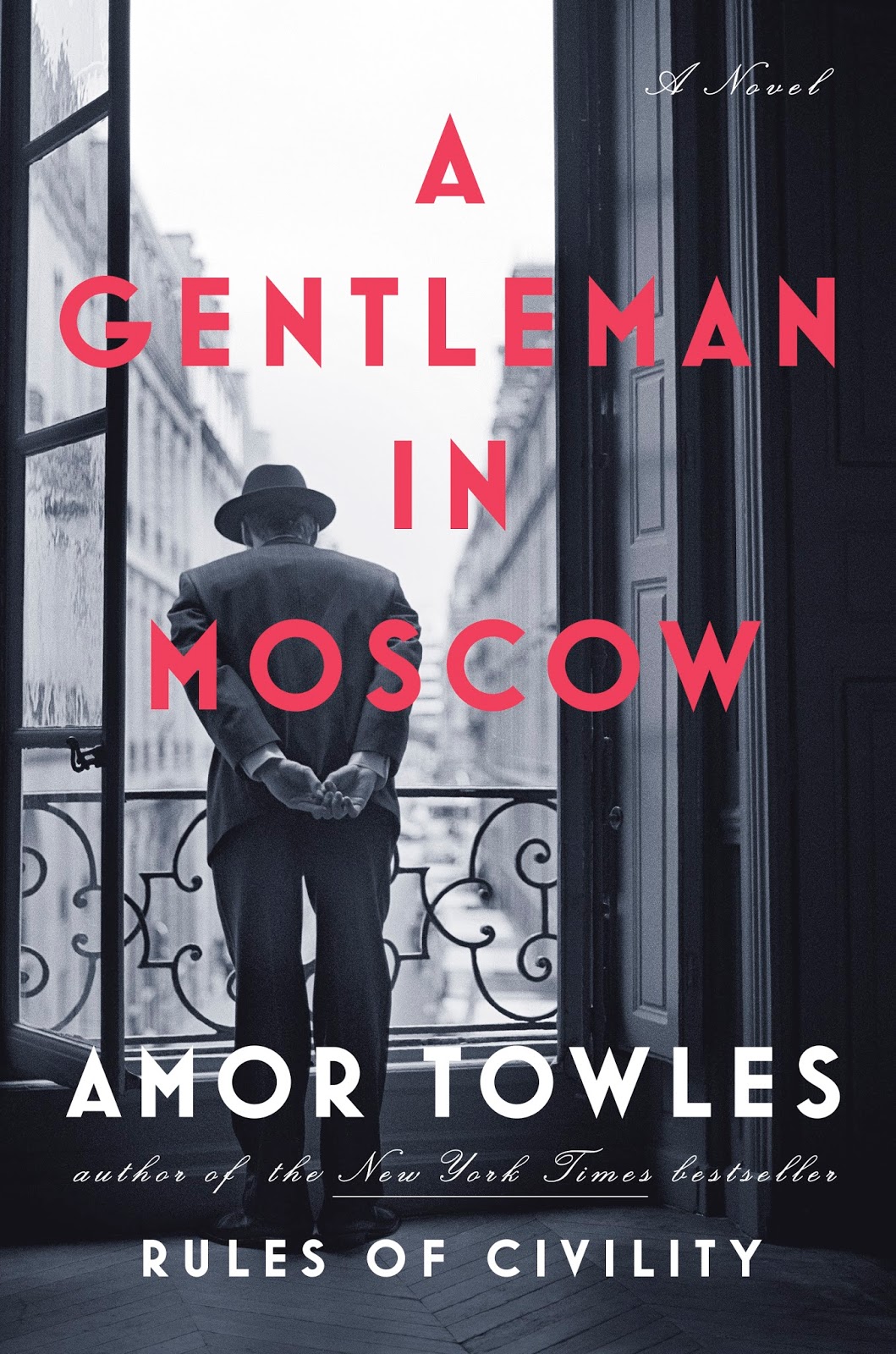
Giveaway - A Gentleman in Moscow - Amor Towles
Amor Towles' debut novel, Rules of Civility. was one of 2011’s 'biggest breakout literary bestsellers.'His second novel, A Gentleman in Moscow, releases September 6/16 and I have a copy to giveaway to one lucky reader!
From the publisher:
"A big novel that embodies the grandiloquent style and spirit of Russia’s Golden Age of literature, A Gentleman in Moscow is a captivating story of personal and emotional discovery that spans more than three decades and takes place almost entirely within the walls of a single building. In 1922, having been deemed an unrepentant aristocrat by a Bolshevik tribunal, Count Alexander Rostov is ordered to spend the rest of his life under house arrest inside the Metropol, a grand hotel across the street from the Kremlin. An indomitable man of elegance, erudition, and wit, the Count has never worked a day in his life, and must now live in a cramped attic room while some of the most tumultuous decades in Russian history are unfolding outside the hotel’s doors. Though stripped of most of his personal possessions and his social standing, the Count remains determined to preserve his dignity and passion for life. As his days are propelled in profound and unanticipated directions, his relationships with the Metropole staff and its guests unlock the doors to larger worlds within the hotel and ultimately himself.
Brimming with humor and wit, an unforgettable cast of characters, and one beautifully rendered scene after another, this remarkable novel casts a spell as it relates the Count’s endeavor to gain a deeper understanding of what it means to be a man of purpose." Read an excerpt of A Gentleman in Moscow.
| Cr: David Jacobs |
Monday, September 28, 2015
Giveaway - The Secret Chord - Geraldine Brooks
Historical fiction fans, have I got a great giveaway for you today!! Geraldine Brooks's newest novel, The Secret Chord, releases October 6/15 and thanks to Viking Books, I have a copy to giveaway to one lucky reader!What's it about? From the publisher:
"A rich and utterly absorbing novel about the life of King David, from the Pulitzer Prize–winning author of People of the Book and March.
With more than two million copies of her novels sold, New York Times bestselling author Geraldine Brooks has achieved both popular and critical acclaim. Now, Brooks takes on one of literature’s richest and most enigmatic figures: a man who shimmers between history and legend. Peeling away the myth to bring David to life in Second Iron Age Israel, Brooks traces the arc of his journey from obscurity to fame, from shepherd to soldier, from hero to traitor, from beloved king to murderous despot and into his remorseful and diminished dotage.
The Secret Chord provides new context for some of the best-known episodes of David’s life while also focusing on others, even more remarkable and emotionally intense, that have been neglected. We see David through the eyes of those who love him or fear him—from the prophet Natan, voice of his conscience, to his wives Mikal, Avigail, and Batsheva, and finally to Solomon, the late-born son who redeems his Lear-like old age. Brooks has an uncanny ability to hear and transform characters from history, and this beautifully written, unvarnished saga of faith, desire, family, ambition, betrayal, and power will enthrall her many fans." Read an excerpt of The Secret Chord.
"Geraldine Brooks is the author of four novels, the Pulitzer Prize–winning Marchand the international bestsellers Caleb’s Crossing, People of the Book, and Year of Wonders. She has also written the acclaimed nonfiction works Nine Parts of Desire and Foreign Correspondence. Her most recent novel, Caleb’s Crossing, was the winner of the New England Book Award for Fiction and the Christianity TodayBook Award, and was a finalist for the Langum Prize in American Historical Fiction. Born and raised in Australia, she lives on Martha’s Vineyard with her husband, the author Tony Horwitz." You can connect with Geraldine Brooks on Twitter, like her on Facebook as well as on her website.Wednesday, March 25, 2015
The Other Joseph - Skip Horack
Every so often I need to take a step back from my usual genres and pick up something completely different. Skip Horack's new book, The Other Joseph, offered up a great opportunity to do just that.Roy Joseph has lost most of his life - his beloved older brother Tommy died in the Gulf War, his parents are both dead and he lives within the narrow confines of a life constricted by a felony conviction. He's chosen to live in a remote area with only a dog for company and he works an isolated job on the oil rigs. Roy has exiled himself from life.
When a young woman contacts him and say that his brother Tommy was her father, he sees a chance - a chance to reconnect with life again, to redeem himself, to perhaps be happy.
Roy's journey physically takes him from Louisiana to San Francisco. He visits locales from their childhood and calls on those who knew his brother along the way. Broken and wounded characters litter the road between Louisiana and San Francisco.
Horack's prose are rich and powerful. They are stark and spare, underlining Roy's solitude. I was overwhelmed by Roy's life - his broken, isolated existence. It was just so very, very sad. I wasn't able to read the book straight through - I simply had to read in small doses. I wanted so badly for the the trip to be Roy's redemption. And of course you're asking - was it? It's hard to say - the ending is not what I wanted at all - Horack did surprise me. I'll have to go with an ambiguous yes and no answer.
The Other Joseph was a moving, eloquent read - one that will leave echoes with you after the last page is turned. Read an excerpt of The Other Joseph.
You can connect with Skip Horack on Twitter as well as on his website.
Wednesday, May 21, 2014
The Promise - Ann Weisgarber- Review AND Giveaway
I read Ann Weisgarber's debut novel, The Personal History of Rachel Dupree, in 2011 and was immediately captured by her storytelling. (my review)Weisgarber's latest book, The Promise, did the same, holding me from first page to last.
Catherine Wainwright is a talented pianist, making her own way in 1899 Ohio. But she makes the mistake of believing a man's interest in her is true. She is marked as a fallen woman and shunned by her family, friends and acquaintances. The man has no intention of leaving his wife. With no one willing to hire or work with her and her debts mounting, Catherine's plight grows increasingly desperate. She casts about for a man that has not heard of her background, sending out letters to renew ties. One man replies - Oscar Williams. Oscar left Ohio as a young man and eventually landed in Galveston, Texas where he makes his living as a farmer. His wife Bernadette has just died, leaving him to raise their four year old son Andre. A local girl, Nan Ogden made Bernadette a promise - to look after Andre. But when Oscar brings home Catherine as his new wife, worlds, emotions and more collide.
Weisgarber has again created very strong, but different, female characters in Catherine and Nan. Both are well drawn, but I found myself drawn more to Nan. Her down to earth, practical attitude belies a caring heart. She is astute enough to sense the attraction between Catherine and Oscar and realize what is inevitable. I had a harder time with Catherine. Although her character transforms as the relationships between the three main characters evolve, I still had a difficult time accepting her.
"Oscar ate with the neighbour men and danced with the women, rural unrefined people, but that hadn't mattered to him. He enjoyed their company. He was without pretense and this, I realized, was what drew me to him."
She, however, is pretending, hiding her past and the desperate need to flee circumstances of her own making.
The narrative is alternated between Catherine and Nan, giving us an insider's view of each woman's thoughts. Interestingly, Oscar is never given a voice of his own. Rather, we learn of and about him from each woman's point of view.
Weisgarber again draws on historical events to set the backdrop for her novel. I was unaware of the geography and history of Galveston Island. (I did, of course, have to Google it after I finished the book.) 1900 Galveston was home to one of the US's greatest natural disasters. A hurricane inundated the island and city, killing 6,000 people in the span of a few hours. This event is pivotal to Weisgarber's story.
The setting is a character in the book as well, the heat and the storm almost tangible in Weisgarber's beautifully descriptive passages. Weisgarber has written a story rich with emotion, detail and history - definitely a recommended read. Read an excerpt of The Promise.
The Promise has been shortlisted for the Walter Scott Prize for Historical Fiction. The winner will be announced June 13, 2014. The other authors on the shortlist are Kate Atkinson, Eleanor Catton, Jim Crace, Andrew Greig, and Robert Harris. The Personal History of Rachel Dupree was long listed for the Orange Prize and short listed for the Orange Award for New Writers.
Friday, May 9, 2014
Waiting For The Man - Arjun Basu - Review AND Giveaway
Waiting for the Man is Arjun Basu's debut novel.Joe is a New York copywriter. He's good at his job, fairly happy and his success has brought him material wealth. Until he starts daydreaming in meetings, floating away from the boardroom and watching himself from above. And then he starts dreaming at night as well. Dreaming of the Man. The Man who tells him to wait. To wait for him. "He had created a need I didn't know I had."
And Joe does just that. He sits on the stoop of his building day and night - waiting for further instructions. Others of course worry and wonder about him. Who is the Man? What has he said to Joe? And without trying or wanting, Joe becomes news. Small at first, then growing exponentially.
Basu easily conveys Joe's sense of dissatisfaction and disillusionment. When I started Waiting For The Man, I could only read a few chapters at a time. Basu provides much food for thought through Joe's ruminations on society, life, familial relationships, the media, religion and much more. It's impossible to read some passages without stopping and looking at them in relation to your own life and circumstances.
But as I continued to read, I became caught up in Joe's waiting. I felt like one of the public, hooked on Joe's story, just waiting for the latest reports form the media crew following his every move.
I was initially confused when the book's narrative abruptly switched time and place in the first few chapters. And then I realized that we learn Joe's story from the beginning and the end in alternating chapters until all is revealed. Or is it? Do we ever find the answers or do we create them ourselves?
Interestingly, I found myself more caught up in the ideas that Joe presented, rather than Joe himself. I ended up feeling quite middle of the road about Joe, neither here nor there. For me, he was simply a vehicle for Basu's exploration of the search for meaning in our lives.
Basu has crafted an unsettling, thought provoking first novel, one sure to leave you taking a second look at many aspects of our society and our own lives. Read an excerpt of Waiting for the Man.
See what other bloggers on the ECW blog tour thought at: Words of Mystery, Buried in Print, A New Day,
"Arjun Basu is a writer and editor. In 2008, he published Squishy, a collection of short stories that was shortlisted for the ReLit Prize. His stories have been published in many literary journals, including Matrix and Joyland. He also writes 140-character short stories he calls Twisters on Twitter (@ArjunBasu), which have won him a Shorty Award, lots of press, and a worldwide following. Arjun lives in Montreal with his wife, son, and dog. You can find Arjun Basu on Facebook as well."
Tuesday, April 16, 2013
The Unchangeable Spots of Leopards - Kristopher Jansma - Review AND Giveaway
I always take the time to read the dedication pages before I begin to read a book. I was intrigued by this entry....."If you believe that you are the author of this book, please contact Haslett &Grouse Publishers (New York, New York) at your first convenience."
We meet the narrator when he is eight years old and has just written his first story, while waiting in an airport's Terminal B for his mother to finish work. We follow the young man to college in his quest to become a writer. It is at college that he meets Julian - a gifted, yet unstable young man. And Julian's friend Evelyn - who will forever be 'the one' for him. The one he writes for, the one he desires, the one he will never have.
The book is divided into two sections - What Was Lost and What Was Found. The first half almost reads like it is Jansma's own road to publication, with the names changed. One piece of advice to the young writer is "Tell all the truth but tell it slant" - a line from a poem by Emily Dickinson. The second half is on a slant - the names change and the narrator assumes the persona of Julian - the more successful of the two. The book is a collection of short stories, of books within books and filled with literary references and asides. For me, it had a distinct Fitzgerald feel - specifically Gatsby.
I enjoyed the first half much more than the second. Jansma explores lies and truth and the weaving of both into fiction. "These stories are all true, but only somewhere else." The second half caught me off guard with some abrupt switches - and I didn't like the narrator as much as I did for the first half. Throughout it all, we are left to wonder - what is the truth and what is fiction. I did adore the ending.
I had just finished watching a movie called The Words, in which a writer claims another man's work as his own - to critical acclaim, when I picked up this book. The movie was about the need to produce a work that will be recognized and will stand after the author has passed. The desire to capture the words, to make people feel the work. Jansma has captured that same desperate pursuit with his narrator and in doing so, has captured us as well.
This is a book that deserves more than one reading - there are layers and themes I know I have missed - connections, references and more, not captured the first time around. Read an excerpt of The Unchangeable Spots of Leopards.
You can find Kristopher Jansma on Twitter and on Facebook. Want to know more about Kristopher - check out this Q&A.
Thanks to Viking Books, I have a copy of this wonderful to giveaway! Open to US and Canada, no PO boxes please. Simply leave a comment to be entered. Ends Sat. May 4.
Monday, September 26, 2011
State of Wonder - Ann Patchett
I've had numerous friends and patrons tell me that I must read Ann Patchett. There's been so much buzz around her latest book, State of Wonder, that I took advantage of an opportunity to listen to it in audio book format.
Dr. Annick Swenson has been working in the deepest jungles of Brazil for over 30 years, following in her former professor's footsteps. They have found an Amazonian tribe whose women give birth as late as their seventies. Drug company Vogel has been financing this venture for many years. Dr. Swenson rarely responds to Vogel's requests for updates. So Vogel sends down one of it's own - Dr. Eckman - to get answers. And then another - Dr. Marina Singh - to find the first.
I could go on and on about the plot - but's it's enough to get you to the Amazon and have an idea. Any more would be a spoiler. Sometimes literary fiction can become too self absorbed for me and feel like a bit of a slog. Not so in this case. I had no idea where Patchett was going to go next with the story - I found myself sitting in my driveway in the dark to finish a disc. (I'd been listening on the way back and forth from work)
The settings came to life - the heat, the insects, the lush and overpowering jungle. Patchett's writing is lush as well. I was truly glad I listened to this book. I don't think I would have become as invested in the story in the written form. Patchett's prose are beautiful, but the reader - Hope Davis - was phenomenal and brought Patchett's words to life. Her voice suited the character of Dr. Singh, expressing her emotions and thoughts perfectly. Davis's voice is rich and well modulated, always evenly paced. She depicted all of the characters very easily with her voice. Dr. Swenson's clipped tones and the Aussie character's accents were spot on.
Lots of themes populate State of Wonder - self discovery, western vs. third world countries, hope, love and more. There will be inevitable comparsons to Joseph Conrad's Heart of Darkness.
I really enjoyed State of Wonder and can see why Patchett has such fervent fans. I would have given this a five star rating, but the ending left me a feeling somewhat unsatisfied and cheated. It seemed to happen in a rush after such a deliberate slow building story. I found myself wanting to know what happened 'after'. Although this could be a good thing as well - an author who leaves you wanting more.
Listen to an excerpt of State of Wonder or Read an excerpt of State of Wonder.
Monday, February 14, 2011
The Weird Sisters - Eleanor Brown
Cordelia (Cordy), Bianca (Bean) and Rosaline (Rose) Andreas are three sisters all named after Shakespearean characters by their father, who is a Bard scholar.
"We wear our names heavily. and though we have tried to escape their influence, they have seeped into us, and we find ourselves living their patterns again and again."
An event in each of their lives has each of them heading home again...
"We came home because we were failures. We wouldn't admit that, of course, not at first, not to ourselves, and certainly not to anyone else. We said we came home because our mother was ill, because we needed a break, a momentary pause before setting off for the Next Big Thing. But the truth was, we had failed and rather than let anyone else know, we crafted careful excuses and alibis and wrapped them around ourselves like a cloak to keep out the cold truth."Each is surprised and not overly happy to find the others there. "See, we love each other. We just don't happen to like each other very much."
What follows is an absolutely mesmerizing story of the complicated relationships between sisters, between parents and children and the search each sister undertakes to find herself and her place in family and life.
"Who would Bean be if she dropped her beautiful mask? Who would Cordy be if she stepped up to the plate in her own life? Who would Rose be if she weren't the responsible one anymore?"Brown's characters fairly leap off the page - I could hear their dialogue and picture their actions so clearly. (And maybe hear some of my own sisters' words as they spoke...)
Brown has a way with words. Some of her descriptive passages had me reading them twice...."Bean pulled a heavy towel form the stack of laundry, unwinding it from the lascivious position it had gotten into with a pillowcase."
The Andreas family are lovers of the written word. They often connect (and dad most often) by quoting Shakespeare passages. "Our family has always communicated its deepest feelings through the words of a man who has been dead for almost four hundred years." Their home overflows with books, often laying about half finished, picked up and read by the next person to pass by. And there's nothing that can't be solved by having a library card. (!)
The Weird Sisters is written in first person plural style. This took me a bit to get used to and I found myself trying to determine who was narrating for the first little bit. But it seemed to work - it seems as each sister is contributing to the narrative, instead of just one of them.
This one was a five star read for me - one to recommend to the women in your life - sisters, mothers, daughters and friends. (Books clubs would love this one too)
Read an excerpt of The Weird Sisters. You can find Eleanor on Facebook as well.
Monday, February 7, 2011
The Help - Kathryn Stockett
"I told Luanne I would write a review of The Help for her blog, because I absolutely loved this book. When I finished it, I did not want to start another book because I didn’t want to let go of these characters. I wanted to keep them with me for just a little bit longer.
However, I find I am having trouble describing all the emotions this book arouses. Let’s start with a description of the plot. The book is set in Jackson, Mississippi in the 1960’s. A time when the light was shining on long-held beliefs and practices like segregation, and “northerners” were coming to Jackson to try to show them another way to do things. As with all great social change, there are still people living their lives, and trying to figure out where they fit in their changing society. This book is the story of three women living in Jackson: two maids, Aibileen and Minny, and one privileged white women, Skeeter. As the world around them starts to show the people of Jackson a different way of doing things, Skeeter starts to question her friends, and most particular Miss Hilly, the chair of the Junior League. Skeeter hatches a plan that she hopes will launch her career as a writer. She plans on writing a book about the experiences of black maids, and Skeeter and Aibileen manage to convince a number of the maids to tell their stories to Skeeter.
From the first page of the book the reader is wrapped in the language and accents of the three women whose stories become intermingled. Stockett moves easily from the accents of Minny and Aibileen, to that of Skeeter and the other white women. There are some touchingly funny moments in the book, as we learn about the relationships the maids have with the children they care for, who eventually become their bosses. Not to give anything way, just know that “toilets” are discussed several times throughout the book.
When we read about Jackson, Mississippi in 1960 it is hard to believe that the world was like that, just 50 years ago. The maids were not allowed to eat at a table with white people. If a maid was out in town during work hours, they had to be dressed accordingly (in their white maid uniform). Slavery had been abolished, but little else seemingly had changed.
There has been criticism of this book – some saying this is just another book by a white woman trying to explain the black experience. I think the important message from the book is about women and their relationships. How situations can throw people together to form unlikely friendships and support systems. Stockett has written a book about great change in the southern states, in an entertaining, personal, and intelligent manner.
I repeat what I said at the beginning; I love this book and have no hesitation recommending it!
Read an excerpt of The Help. The movie version of The Help will be released in August 2011.
What a great review! As always, thanks Julia!
Friday, January 21, 2011
Incendiary - Chris Cleave
Incendiary is told in the form of a long rambling letter to Osama Bin Laden by an unnamed female narrator. Osama's forces bombed the football stadium where her husband and son were attending a game. They, along with thousands of others, were killed.
"I want to be the last mother in the world who ever has to write a letter like this. Who ever has to write to you Osama about her dead boy."
The narrative rambles and meanders as she attempts to deal with her loss and grief. The lack of puncuation and run on sentences only serve to emphasize her state of mind. Her sorrow and anguish are palpable. The terror and confusion of the aftermath of an attack to both the city and it's citizens is sharply drawn. I was appalled and horrified by some of the situations she finds herself in - the other two supporting characters were quite ugly in many ways - but I couldn't stop turning page after page.
Powerful, moving, yes - humourous, frightening, disturbing, heart breaking, but oh, what an addicting read. See for yourself - read an excerpt of Incendiary
I'm saddened to think that she won't be the last mother in the world who will want to write a letter like this....
Monday, January 10, 2011
Secret Daughter - Shilpi Somaya Gowda
"Apparently international bestseller, Secret Daughter, has been made such a hit, in part, by the fact that Canadians loved this book. I count myself as one of those admirers.
First, the story. Secret Daughter is about a woman, Kavita, from a small village in India who takes her second daughter to an orphanage, after her first daughter is taken away at birth and murdered by her husband’s family. Across the ocean, in California, a young couple, Somer and Krishnan, are faced with the fact that they will not be able to have children of their own. The husband is from India, and his mother helps to facilitate an adoption from an orphanage in India. Of course, the baby they adopt is the one given up by Kavita.
From there, the novel switches back and forth between the two families. We read about the struggle of living in India, and the forever pain that Kavita has at losing her daughter. In California, Somer is living with a different kind of pain as her teenage daughter begins to demand answers about her real family, and yearns to learn more about India, a country and culture that are foreign to Somer.
Eventually the novel switches to focus on Asha, the daughter. She travels to India and spends time with her grandmother, learning to love her native country.
This book has so many thought-provoking themes. We read about India, seen through the eyes of different people. The smells, the sounds, the food, are all brought to life in vivid detail. There are stories about finding your self – both literally, as Asha tries to discover her roots, and also for Somer as she tries to rediscover the person she once was.
For me, the theme in this book that touched me the most was the story of moms and hope and love. The main characters tell their stories of what it means to be a mom – Somer, Kavita, Krisnan’s mother (Dadima). But there are also the stories of the mothers that Asha meets in the Dubai slums. The book is a reminder that families come in many different forms, are constituted out of the most unlikely relationships. They endure in large part because of the deep love we, as mothers, have for our children.
So, give yourself a little gift, curl up before the fire on a snowy afternoon this winter and read Secret Daughter. I promise you it will enrich your understanding of your own family."
Read an excerpt of Secret Daughter. This would be a great selection for a book club as well - Gowda has provided a set of discussion questions.
A great review - thanks Julia! Also reviewed by Mystica, who also gave it a resounding thumbs up. And also just chosen as a certified 'Savvy Read' by Harper Collins Canada.
Tuesday, January 4, 2011
The Lake of Dreams - Kim Edwards
Lucy Jarrett lives in Japan with her boyfriend Yoshi. She is between jobs and somewhat uncertain of what the future holds for her. When an email from her brother arrives, mentioning that her widowed mother has been slightly injured in a fall, Lucy decides to go home for a visit. The visit stirs up memories of her father's death. Nothing is as it was, her mother and her brother Blake are moving on with their lives.
"All these years I'd taken such comfort in my wandering life, but really I'd been as anchored to the night my father died as Blake had been, circling it from afar, still caught within its gravity. Now Blake was moving on, and my mother was, too; the feeling I'd been fighting all day, the feeling of being adrift by myself in a vast dark space, engulfed me for a moment."
In the cupola of the family home, Lucy discovers a cache of items that suggest the family history as she knows it, isn't quite the whole story. As Lucy pursues the story behind the items, history reaches forward to change the course of the present.
The characters were especially well drawn, each entirely believable. The emotions and situations were convincing and rang true - Lucy's exploration of her feelings with an old flame, her mother's burgeoning relationship with a new flame and more. It was the exploration of the past that enthralled me though. I found myself flipping ahead, looking for the italicized type that indicated a letter from the past. These letters were especially poignant - the emotions and circumstances that surround them were both addicting and heart rending.
The story flows seamlessly, blending the past and present together with vibrant details. The descriptions of glass blowing are vivid and sensual. The use of unsettled weather to mirror Lucy's emotional state is particularly effective. The settings are lushly depicted.
Edwards has crafted an incredibly rich, multi layered story, with threads reaching from one storyline to the next, finally joining them together in a satisfying conclusion.
"Whatever its beginning, the story had unfolded, one event leading to the next, beauty and loss surfacing in every generation, until I sat here, a hundred years away from the comet, woven into the story in ways no one could ever have imagined."
A satisfying read - definitely recommended. Read an excerpt of The Lake of Dreams.
Tuesday, September 28, 2010
Red Hook Road - Ayelet Waldman
Red Hook Road follows the aftermath of this tragedy over the course of four years and the effect on the family and friends left behind.
The two mothers - Iris Copaken and Jane Tetherly are the main characters and the ones we come to know the best. Waldman's strength lies in her characterizations. I truly disliked Iris despite her losses. Her sense of right, her scheming and manipulations added up to someone I would not enjoy knowing. Although her actions are not all bad, it is the way she achieves them that I found objectionable. Jane is portrayed a a 'typical' Mainer - stoic, spare with words and hard working. Despite her brusqueness she is the character I enjoyed the most. Supporting characters are just as strongly drawn, particularly Iris's father.
The sea, boats and classical music all play a role in the novel and are used by Waldman as allegorical vehicles.
Those looking for an action filled story won't find it here. Rather, they will find a thoughtful, carefully portrayed narrative of the feelings, emotions and actions of those left grieving after a heartbreaking loss.
Read an excerpt of Red Hook Road.