Showing posts with label dual narrative. Show all posts

Monday, October 17, 2022

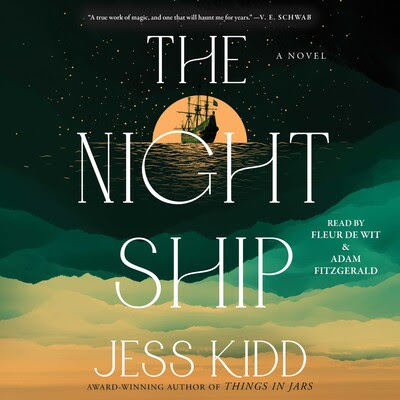
The Night Ship - Jess Kidd

I've enjoyed Jess Kidd's previous novels and happily picked up her latest - The Night Ship.

Kidd's new novel takes inspiration from an actual historic event - the sinking of the Dutch ship Batavia in 1628. Historical figures are part of the book as well. Our narrator, a nine year old girl named Mayken, is fictional.  

Three hundred years in the future (1989), a nine year old boy named Gil comes to visit his grandfather on the island that was the site of the sinking of the Batavia. He is the narrator of this time as well. 

I found myself more drawn to Mayken and her time span. I am fascinated by this point in history and this book being partially true, drew me in. Mayken also has a feistier attitude, she's clever, bold and brave. Gil has had a difficult upbringing so far. The island is not a refuge for him and his grandfather is distanced. But....I really had a hard time trying to find empathy for Gil. He is the author of many of his own problems. Again, I reminded myself he has had a traumatic childhood. I found a number of the supporting cast in this time period to be overdrawn and over the top. Some of Mayken's actions also require a few grains of salt - but I found I was happy to do that. 

Tying the two together is a mythical creature and a relic that has survived the years. That, and the fact that they are both children struggling in difficult situations. I have to admit, as the book progressed, I was expecting something more, something more concrete or hoping for something more concrete, something bigger, but it never materialized.

I wish the protagonists would have been older and in their teens. I would have found the narratives more believable. Nine year old protagonists are a bit too young for me.   

This was a mixed bag for me. I really enjoyed the historical chapters, but I wasn't drawn to Gil's narrative at all. It's almost like there are two books being told in alternating chapters with not enough to tie them together. I'm an outlier on this one I think. I encourage you to take a look at the other reviews on Goodreads. 

I chose to listen to The Night Ship. The narrators were Fleur De Wit and Adam Fitzgerald. De Wit narrated Mayken's story and Fitzgerald voiced Gil's. De Wit has a pleasant voice that is easy on the ears. She enunciates well and speaks at a measured pace. Her voice has movement. I did find her esses to be a bit sibilant. She provides a child's voice for Mayken. Unfortunately I found it became annoying about halfway through the book and too cutesy. Fitzgerald has a strong Aussie accent that I loved. Some may find it takes a bit getting used to. His reading is expressive and captures the plot. He does not provide a different, younger voice for Gil. Instead this time period is told in one voice. Hear for yourself - listen to an audio excerpt of The Night Ship

Tuesday, March 26, 2013

The House Girl - Tara Conklin

 The House Girl marks Tara Conklin's debut novel.

The story is told in two narratives - that of Josephine a 17 yr old house slave in 1850's Virginia and Lina - a class action lawyer in 2004 New York.

The opening chapter belonged to Josephine and I was immediately captivated. She is planning to run - and it won't be the first time.

“Mister hit Josephine with the palm of his hand across her left cheek and it was then she knew she would run.  She heard the whistle of the blow, felt the sting of skin against skin, her head spun and she was looking back over her right shoulder, down to the fields where the few men Mister had left were working the tobacco.” 

Lina's law firm is looking for the "perfect plaintiff" to be the 'face' of a lawsuit being brought, seeking reparations for descendants of American slaves. She stumbles across Josephine's name through her father's work. He is an artist and there is great controversy concerning who really painted a series of paintings attributed to Josephine's 'Missus' - Lu Anne Bell. Was it Lu Anne or was it the slave Josephine?

Lina's narrative follows the search for the descendants and I found this part of the story extremely interesting. Lina is also going through her own personal difficulties - she has her own family issues that have been left untended for many years. I wanted to like Lina more than I did. Although she is a high powered lawyer, she is still a petulant child with her father. And given that she is highly intelligent and quite adept at research,  I cannot believe that she never sought to confirm the details of her mother's life and death. By the middle of the book I found myself speed reading through her sections.

It was Josephine's story that grabbed my heart and wouldn't let go. I know it's a fictionalization, but Conklin has based her novel on facts. Heartbreaking facts. Additional narrators are introduced through their letters - that of a slave doctor and a young woman whose home was a stop on the Underground Railroad. I enjoyed these sections very much as well.

I chose to listen to The House Girl. The reader was Bahni Turpin. She was excellent - her interpretation of Josephine chillingly brought her story to life. The cadence and tone she used for Lina was completely different of course, but I found it matched what I thought of Lina - a bit whiny. The accents used for other characters - especially that of Lu Anne Bell were excellent and believable.

This one is poised to be the darling of book clubs everywhere. There is a reading group guide. I did enjoy this debut effort, but there are other books dealing with slavery (and in a deeper manner) that I would recommend ahead of this title. Still, it was an entertaining listen. Listen to an excerpt. Or start off reading an excerpt of The House Girl.

You can find Tara Conklin on Facebook and on Twitter.